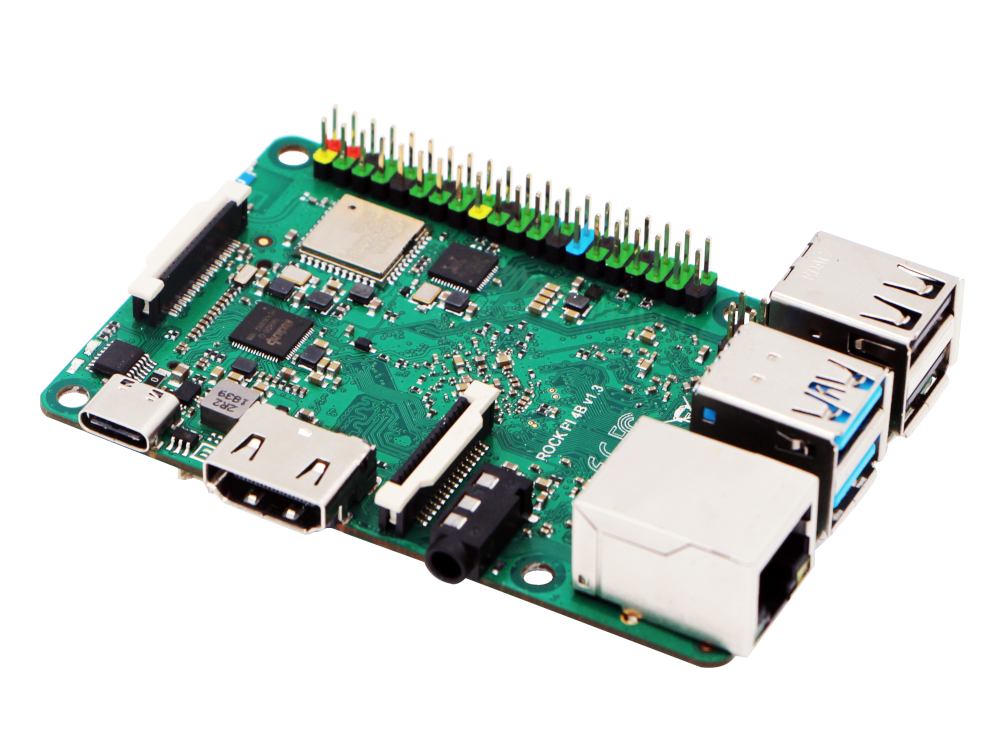
Introduce ROCK 4

ROCK 4 is a Single Board Computer (SBC) in an ultra-small form factor that offers class-leading performance while leveraging outstanding mechanical compatibility. The ROCK 4 offers makers, IoT enthusiasts, hobbyists, PC DIY enthusiasts and others a reliable and extremely capable platform for building and tinkering their ideas into reality.

Image

Class-Leading Performance

ROCK 4 has a modern and powerful hexa-core ARM based processor, RK3399 inside, it offers significantly improved performance versus other popular SBC boards. All models are equipped with LPDDR4 3200Mb/s RAM and optional high performance eMMC modules, boost all applications.

Read More
Image
Image

Maker Friendly, IoT Connectivity

ROCK 4 features maker friendly expansion options, including a 40-pin GPIO interface that allow for interfacing with a range inputs from buttons, switches, sensors, LEDs, and much more.

ROCK 4 also features a Gbit LAN for network, with dedicated bus and controller, it works without latency under heavy load network applications. On board 802.11 ac wifi offers 2.4G & 5G WLAN connectivity. With Bluetooh 5.0, ROCK 4 benefits improved Bluetooth speed and greater range.

ROCK 4 also features one USB 3.0 host and one USB 3.0 OTG ports, each 5Gbps/s, working independently. The USB 3.0 OTG can work as USB device such as Android ADB or USB gadgets. A hardware switch is provided for OTG mode switch.

Read More

AI Capabilities

ROCK 4 supports mainstream AI stack with GPU acceleration. Further more, a dedicated hardware NPU accelerator coming up next for ROCK 4 will boosts complex Machine Learning algorithm and reduce the power.

Industrial standard MIPI CSI connector makes it easy to connect exsit cameras to ROCK 4 and ROCK 4 also supports industrial standard MIPI DSI for LCD and touch screen. With hardware accelerated algorithm, it's great for Computer Vision application, Robotics and much more.

Read More
Image

- 8.17.2.14 - Vmware Inc. - Display

The most common way to install version 8.17.2.14 is by installing or upgrading within the guest OS. VMware SVGA 3D v.8.17.2.1 on Windows2019 Server

VMware publishes these drivers directly to the Microsoft Update Catalog . This allows IT administrators to push updates via (Windows Server Update Services) or for individual users to receive them through standard Windows updates. B. VMware Tools Integration

There are two primary ways to acquire and install this specific driver version: A. Windows Update vmware inc. - display - 8.17.2.14

Facilitates the use of multiple displays within a single virtual session. 3. Installation and Updates

Version was officially released on March 11, 2021 . It is specifically designed to provide high-performance 2D and 3D graphics acceleration for VMs running the following operating systems: Windows 7 and Windows Server 2008 R2 Windows 8 and Windows Server 2012 Windows 8.1 and Windows Server 2012 R2 The most common way to install version 8

The search term refers to a specific version of the VMware SVGA 3D display driver . Released primarily for legacy Windows operating systems, this driver is a critical component of VMware Tools , the suite of utilities that optimizes virtual machine (VM) performance. 1. Driver Overview and Compatibility

Eliminates "cursor lag" by synchronizing mouse input between the host and guest. Without a proper display driver

Without a proper display driver, a guest operating system in a virtual environment often suffers from poor resolution and lag. The 8.17.2.14 driver addresses these issues by enabling:

Allows the VM window to be resized automatically to fit the user's console or remote desktop window.

For newer operating systems like Windows 10 and 11, VMware typically utilizes the series of display drivers (e.g., version 9.17.5.1). 2. Key Functions of the VMware SVGA 3D Driver

The most common way to install version 8.17.2.14 is by installing or upgrading within the guest OS. VMware SVGA 3D v.8.17.2.1 on Windows2019 Server

VMware publishes these drivers directly to the Microsoft Update Catalog . This allows IT administrators to push updates via (Windows Server Update Services) or for individual users to receive them through standard Windows updates. B. VMware Tools Integration

There are two primary ways to acquire and install this specific driver version: A. Windows Update

Facilitates the use of multiple displays within a single virtual session. 3. Installation and Updates

Version was officially released on March 11, 2021 . It is specifically designed to provide high-performance 2D and 3D graphics acceleration for VMs running the following operating systems: Windows 7 and Windows Server 2008 R2 Windows 8 and Windows Server 2012 Windows 8.1 and Windows Server 2012 R2

The search term refers to a specific version of the VMware SVGA 3D display driver . Released primarily for legacy Windows operating systems, this driver is a critical component of VMware Tools , the suite of utilities that optimizes virtual machine (VM) performance. 1. Driver Overview and Compatibility

Eliminates "cursor lag" by synchronizing mouse input between the host and guest.

Without a proper display driver, a guest operating system in a virtual environment often suffers from poor resolution and lag. The 8.17.2.14 driver addresses these issues by enabling:

Allows the VM window to be resized automatically to fit the user's console or remote desktop window.

For newer operating systems like Windows 10 and 11, VMware typically utilizes the series of display drivers (e.g., version 9.17.5.1). 2. Key Functions of the VMware SVGA 3D Driver
Have Any Question ?

Send us a email with your questions

Call Us :

+86 755 2778 4863

Mail Us :

[email protected]

Find Us :

B53, 4F, Rainbow City
Xixiang, Baoan
Shenzhen, China

Follow Us :